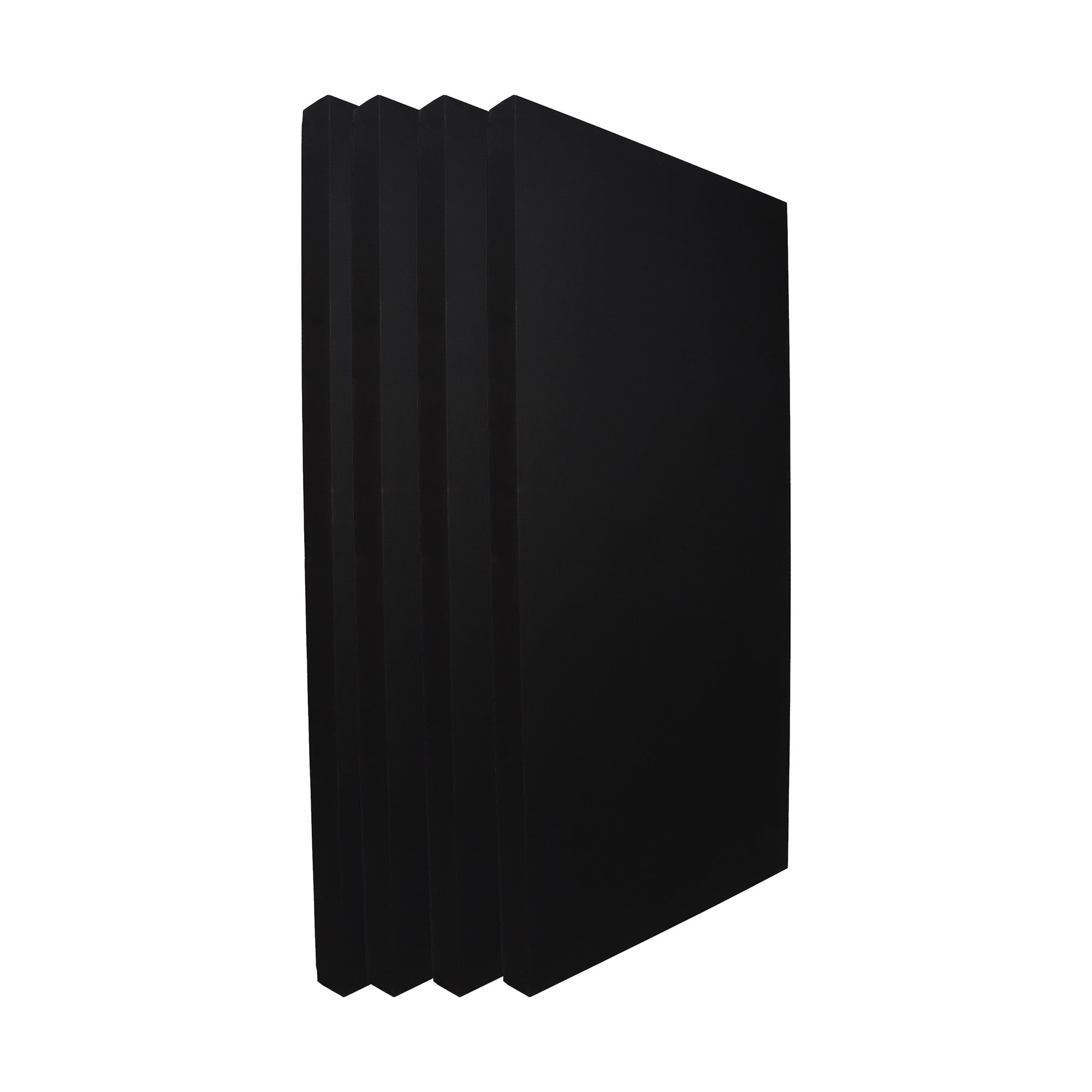
Can you sound proof with acoustic panels?
Few houses or buildings are designed with sound quality in mind. Old houses seem to let sound pass through like a sieve, and rectangular rooms with plaster walls create all sorts of sound problems. There are many solutions to address these issues, but which one to choose?
To answer this question, we need to understand the difference between soundproofing and acoustic treatment.
Soundproofing
Soundproofing refers to building work that will prevent sound from passing from one place to another.
If you are in a shared living space, a semi-detached house, or if a family member plays a musical instrument, you probably want to find a way to no longer hear noise from your bedroom. There are some inexpensive ways to reduce sound, but to make a real difference, you will need to undertake major renovations to your building.
First solution: Seal the holes
Imagine the sound you hear is like a liquid. You need to seal all the holes between the room to be soundproofed and the source of the noise to prevent the sound from infiltrating. Start with the place where the sound passes most easily: the door. To seal the door edges, you can easily install a weatherstrip or a door seal that compresses when the door is closed. For the bottom of the door, a door sweep can be installed to drop down in front of the door. If your door is hollow, replacing it with a solid door can prevent even more sound from passing through.

Second solution: Add mass

If you still hear noise after sealing the door well, it's because you hear the sound through the walls. Bass and mid-range frequencies vibrate the walls like a guitar or violin, using them to amplify. To make a real difference, you will need to undertake major renovations.
Many solutions exist, but the most effective one, according to Bobby Owsinski, a sound engineer and lecturer, is to increase the distance between the walls. A distance of two feet between the walls, along with installing soundproofing wool on each wall, can drastically reduce external sound. The air between the walls stops the sound as it travels through the air and prevents it from vibrating the walls to amplify.
Of course, renovations of this magnitude are not affordable or feasible in most cases. That's why many people turn to acoustic panels, which are much cheaper and easier to install. However, these cannot prevent sound from passing from one room to another since they are installed on the walls or ceiling. But they are extremely effective at treating the acoustics of the room in which they are installed and reducing sound.
Acoustic Treatment
Acoustic treatment, the expertise of Studio Solution, aims to control the sound inside a room and make it more pleasant and natural. Our rooms are often square or rectangular, creating problems with sound. Plaster walls or windows are also problematic since they are hard and bounce sound everywhere in your room. Good acoustic treatment with acoustic panels can control frequencies and prevent them from spreading.
Home Studio
If you are a musician or sound engineer, treating the acoustics of your room becomes essential. Have you ever played the guitar in a small room and noticed that some notes instantly filled the room, resulting in aggressive resonance? Without surfaces to absorb them, the frequencies of your instrument will bounce endlessly in the room, making it resonate in a very unpleasant way. The problem is worse in the corners of the walls. Sound can bounce very quickly there, creating a sound mass, sometimes similar to a car engine.
What to do to solve the problem? Install Echo-Hemp acoustic panels Hemp wool can absorb frequencies from 60 Hz to over 4000 Hz, providing excellent coverage. A good starting point is to install Bass Traps (6-inch thick panels) in the corners of your room to absorb the low frequencies that accumulate there. Then, covering about 50% of the walls with 24''x48''x3'' panels can prevent frequencies from bouncing from one wall to another. Also, do not neglect the ceiling, which is often the largest empty surface in a room. Installing panels on the ceiling can greatly help improve the acoustics of your space.

Acoustic foam, very popular on Amazon and eBay, can only absorb high frequencies; its only purpose is to complement a room where acoustic panels have already been installed, and high frequencies are problematic.
Here are some tips if you are into music production or mixing:
- Install a panel behind each speaker to control reflections on the rear wall.
- Install a panel to your right and left.
- Install bass traps in each corner of your room.
- Hang a cloud directly above your listening position.
Echo Reduction

The absence of acoustic panels in a large space like an office or a restaurant dining room can significantly affect sound quality. If sound can travel and bounce freely in the room, it will accumulate to create a massive sound mass called echo. It is more pleasant to work or converse in a space where sound is more controlled and calm.
To reduce echo, you can suspend acoustic panels from the ceiling, trying to achieve a coverage of at least 50%. Then, you can complement with acoustic panels on the walls. Reverberation will be absorbed by the rock wool contained in the panels.
Reducing echo can mitigate noise inside your room, making the sound of your voice less disturbing to other occupants of your home. Very useful for hearing your partner less while telecommuting.
In Conclusion
Although they can be easily confused at first glance, soundproofing and acoustic treatment are two completely different processes. One aims to prevent sound from passing from one place to another, while the other improves the sound quality inside a closed space.
Do you have questions about acoustics? You can contact us; we will be happy to help!
 $174.99
Panneau Acoustique Écho-Écono 24"x48"x2.75"
- $699.99
Kit Écho-Écono 4 x 24"x48"x2.75"
- $49.99
Acoustuile Écho-Chanvre 24"x48"x1.5"
- $449.99
Bass Trap à Membrane Écho-Chanvre 24"x24"x8"
- $234.99
Panneau Acoustique Écho-Chanvre 24"x48"x2.75"
- $229.99
Panneau Acoustique Écho-Écono 24"x48"x5.5"
- $299.99
Panneau Acoustique Écho-Écono 46.5"x48"x2.75"
- $124.99
Panneau Acoustique Écho-Écono 12"x48"x2.75"
- $164.99
Panneau Acoustique Écho-Chanvre 12"x48"x2.75"
- $399.99
Panneau Acoustique Écho-Chanvre 46.5"x48"x2.75"
- $349.95
Panneau Acoustique Diffu-Chanvre 24"x24"x3"
- $649.99
Prime 116 Quadratic Diffuser
- $499.95
Acoustic spectrogram test